Most people buy a window screen once and expect it to last years. Most screens don’t.
They tear under a cat’s claw. They sag under a dog’s lean. They clog with dust and pollen until the airflow stops. They grow mould in damp climates, go brittle in cold ones, and leave a gap at the edge that lets in exactly what they were meant to keep out.
The reason isn’t bad luck. It’s that most screens are built to a standard size, a standard mesh and a standard frame — and no real home matches all three. This page is about what actually determines whether a screen survives, and how to specify one that does.
The Four Things That Decide Whether a Screen Lasts The weave density. Coarser mesh allows more airflow but lets fine dust, pollen and small insects straight through. Finer mesh captures more, but clogs faster and must be washable. There is no single correct answer — it depends on your climate and what you’re trying to keep out.
The mesh material. Synthetic mesh is lighter and more transparent, but absorbs moisture and degrades under UV. Stainless steel is non-absorbent, mould-resistant, corrosion-resistant and doesn’t go brittle in cold. In humid, coastal and cold climates, the difference is a season versus years.
The frame rigidity. A flexible frame flexes when a pet leans on it, works loose at the fixings, and eventually tears the mesh. Rigid aluminium doesn’t.
The fit. A screen that doesn’t sit flush leaves an edge gap. And an edge gap lets in as much dust and as many insects as an open window. Custom cutting is the only way to close it.
Where Screens Fail, Region by Region Coastal and salt-air regions. Salt corrodes cheap metal within months. Humidity keeps synthetic mesh damp and mouldy. Wind works loose anything that isn’t rigid. Stainless steel mesh and aluminium frames are the only specification that holds.
Desert and arid regions. Fine sand passes through coarse mesh. Dust storms load a screen in days. Heat and UV make synthetic mesh brittle and warp cheap frames. Ultra-fine stainless steel weave is the practical answer.
Tropical and humid regions. Synthetic mesh stays wet and supports mould growth. Once mould establishes, it releases spores into the room every time air passes through. Non-absorbent stainless steel doesn’t.
Cold and snowy regions. Synthetic mesh goes brittle below freezing and cracks under impact. Cheap frames contract and lose their seal. Stainless steel mesh and aluminium frames don’t.
Urban and high-pollution regions. Fine particulate passes through coarse mesh and clogs fine mesh quickly. Soot stains cheap synthetic weave permanently. Smooth stainless steel wipes clean.
Rental markets. Drilling costs the deposit. Adhesive fixing, fully reversible, is the only practical option for a large share of households.
What We Actually Make We manufacture custom pet-proof dust screens, retractable screens, magnetic insect nets, pet-proof screen doors and folding screen doors in our 12,000㎡ factory in Foshan, and ship them factory-direct to more than 40 countries.
Pet-proof dust screens — fixed adhesive panels, ultra-fine mesh or stainless steel, aluminium frames, cut to your measured opening.
Retractable screens — pull across when needed, retract into a housing when not.
Magnetic insect nets — magnetic fixing, quick removal and refitting, no tools.
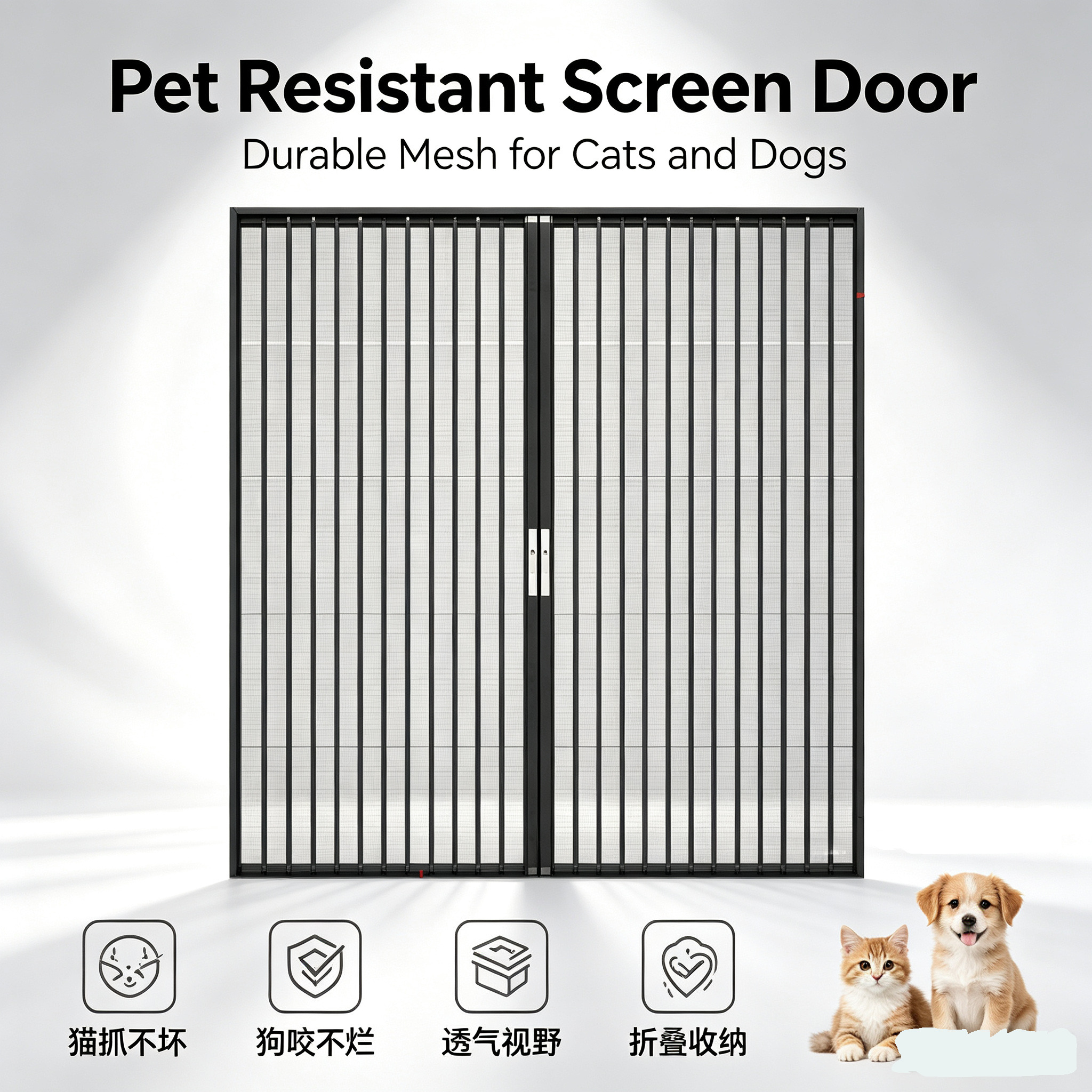
Pet-proof screen doors — heavy-duty mesh for back doors, patio doors and garden doors.
Folding screen doors (FD01) — aluminium alloy frame, PVC transparent, aluminium or perforated panels, opens from the centre and folds back to 5–8cm.
The Details That Matter in Practice Adhesive fixing, not screws. No drilling into frames, sills, render or cladding. Fully reversible. For rentals, it protects the deposit. For heritage properties, it leaves the historic fabric untouched.
Clip-out panels. Press the catches, lift the panel out, rinse it under a tap, let it dry, clip it back. A screen that can’t be cleaned properly isn’t a filter — it’s a dust trap.
Custom cutting, including irregular openings. Period terraces, conversions, bay windows, arched openings and non-standard frames are the normal case for us, not the exception.
Consistent specification across a property. Every opening produced to one mesh, one frame finish and one fixing method, so the building reads as a whole and replacements match.
What We Need From You Your country and city — so we can match the mesh and frame to the climate
Your window or door dimensions — width and height, minimum measurements
Photos of the openings — so we can confirm the fit before production
Your pets — cats, dogs or both, and whether they scratch, chew or charge
Your property type — house, villa, apartment, rental, commercial
We’ll recommend the specification and reply within 24 hours with a detailed quotation.
Shipping We ship factory-direct from Foshan to over 40 countries.
Sea freight — 20FT/40FT containers, LCL or FCL, 15–35 days, most economical
Air freight — 5–10 days for urgent orders
Rail transport — Europe and Central Asia, 18–25 days
Express (DHL/FedEx) — samples and small orders, 3–7 days, door-to-door
Customs support and full logistics coordination included. Bulk production takes 15–25 days.
Get a Free Quote Send us your dimensions, photos and your country. Tell us whether you have cats, dogs or both, and where you live. We’ll recommend the right mesh and frame for your household and climate and reply within 24 hours.
WhatsApp: FSMBOR — send your size and country Email: reply within 24 hours
Message us your dimensions for a free quote.
Global pet-proof dust screens — ultra-fine mesh and 304 stainless steel, aluminium frames, 3M adhesive fixing without drilling, removable and washable panels, specified by climate and pet profile, manufactured in Foshan and shipped to over 40 countries.