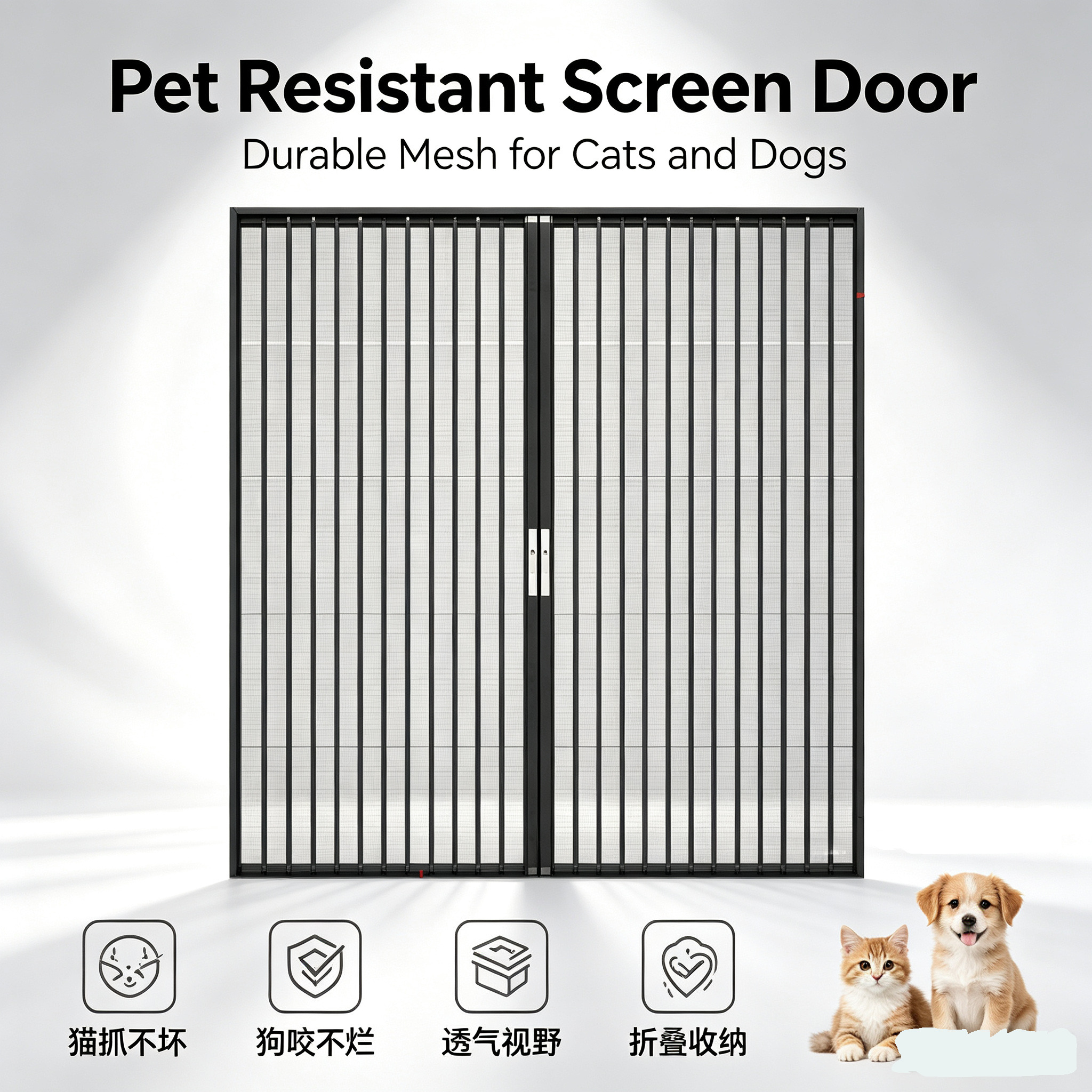
Pet-proof” is one of those terms that gets used loosely. A screen sold as pet-proof might resist a cat’s claw for a season, or it might survive a Labrador charging the patio door for five years. The difference isn’t marketing. It’s mesh, frame and fit.
This page is about what pet-proof actually means in practice — what cats and dogs do to screens, what specification resists each type of damage, and how to tell whether a product will hold up in your household.
What Cats Actually Do to Screens Cats don’t charge screens. They test them.
A cat sits on the sill, watches a bird, and hooks a claw into the mesh to get closer. It climbs the screen to reach an insect. It pushes against the panel when it wants out. It leans on the frame when it’s watching something.
The damage mode is claw snagging. A claw catches a strand of mesh and pulls. On nylon and fibreglass, the strand breaks or stretches, and the weave begins to unravel from that point. Within weeks, the screen has a run of loose threads and a visible hole.
What resists it:
PET fiber mesh — a resilient synthetic weave that resists claw snagging and keeps its shape. The right choice for cats that scratch rather than charge.
304 stainless steel mesh — densely woven, non-deformable, and effectively immune to claw damage. The choice for cats that climb, or for households where the window is the cat’s main occupation.
What Dogs Actually Do to Screens Dogs do charge screens.
A dog sees the postman, the neighbour’s cat, or the garden, and hits the door at speed. It pushes against the panel with its nose and paws. It leans on the frame when it wants back in. A determined chewer will bite the edge.
The damage modes are impact, deformation and edge failure. Fiberglass and nylon mesh stretches, sags and tears at the frame edge. Cheap frames flex and work loose at the fixings. Once the mesh is loose, the screen stops sealing — and stops working.
What resists it:
304 stainless steel mesh — impact-resistant, non-deforming, and the only realistic specification for a dog that charges a door.
Rigid aluminium frames — no flex under impact, no working loose at the fixings.
Reinforced edge fixing — holds the mesh at the frame when the panel is pushed.
What Both Do Over Time Hair and dander. Pet hair and dander settle into the mesh. Coarse mesh lets them through; fine mesh catches them, but must be washable. A screen that can’t be removed and rinsed becomes a reservoir.
Moisture from paws and coats. A wet dog brings moisture to the screen. Synthetic mesh absorbs it and supports mould. Stainless steel doesn’t.
Repeated contact. A pet leaning on the same spot every day will eventually deform a flexible frame. Rigid aluminium doesn’t deform.
Why Mesh Alone Isn’t Enough A pet-proof mesh in a flexible frame is not a pet-proof screen. The frame flexes, the mesh loosens at the edge, and the screen fails — even though the mesh itself is intact.
Three things have to be right together:
Mesh — resistant to the specific damage mode (claw or impact)
Frame — rigid enough not to flex under contact
Fit — flush to the opening, with no edge gap
Miss any one of them and the screen fails at that point.
How to Tell Whether a Screen Is Genuinely Pet-Proof Ask these questions before you buy:
What mesh is it? If the answer is “standard insect mesh” or “fiberglass”, it isn’t pet-proof. It’s insect mesh.
What’s the frame? If the answer is flexible plastic or thin-gauge aluminium, it will flex under a pet.
Is it cut to my opening? If the answer is “standard sizes”, it will leave an edge gap.
Can it be removed for cleaning? If the answer is no, it will clog and stay clogged.
What happens if my pet damages it? If the answer is “buy a whole new screen”, the specification is wrong. Replacement panels should be available individually.
Our Specification For cats: PET fiber mesh or 304 stainless steel mesh, in a rigid aluminium frame, cut to the measured opening.
For dogs: 304 stainless steel mesh, in a rigid aluminium frame, cut to the measured opening, with reinforced edge fixing and a screw-fixed option for high-traffic doorways.
For both: removable panels, adhesive fixing without drilling, and replacement panels available individually.
A Note on “Pet-Proof” as a Claim No screen is indestructible. A dog can chew through anything if it’s determined enough, and a cat can find the one weak point in any installation.
What pet-proof means in practice is: the mesh resists the normal damage mode, the frame doesn’t flex, the fit leaves no edge gap, and the panel can be cleaned and replaced without replacing the whole system.
That’s the standard we build to.
Get a Free Quote Send us your dimensions, photos and your country. Tell us whether you have cats, dogs or both, and what they do to screens — scratch, climb, charge or chew. We’ll recommend the right mesh and frame and reply within 24 hours.
WhatsApp: FSMBOR — send your size and country Email: reply within 24 hours
Message us your dimensions for a free quote.
Global pet-proof dust screens — PET fiber mesh for claw resistance, 304 stainless steel mesh for impact resistance, rigid aluminium frames, custom-cut to the opening, adhesive fixing without drilling, removable and washable panels, manufactured in Foshan and shipped to over 40 countries.