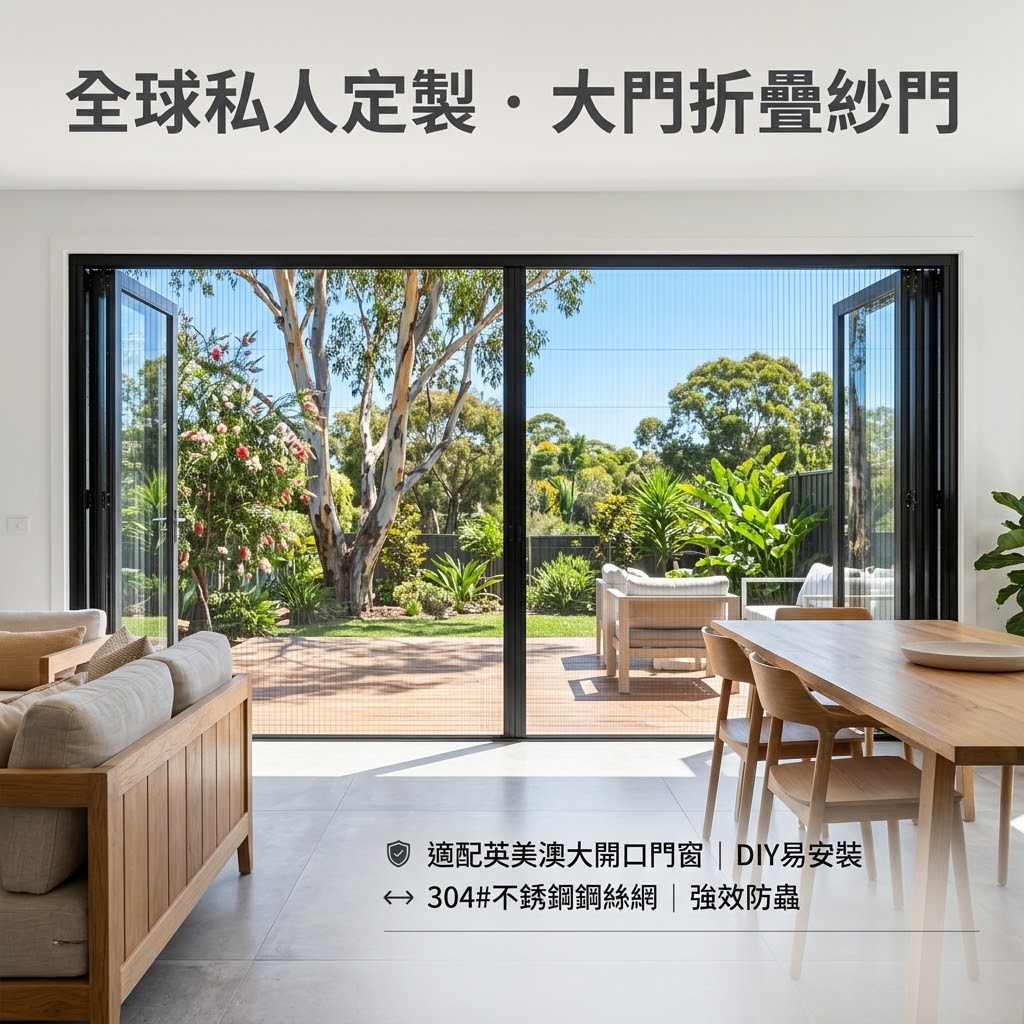
How to Keep Mosquitoes Out Without Blocking the View
There is a trade-off most homeowners accept without questioning: if you want to keep mosquitoes out, you have to give up your view.
Standard window screens are visible. The mesh is dark, the weave is coarse, and the window that once framed a garden now looks like it is covered in a grey film. Many people leave their screens off simply because they prefer the view — and then spend the summer swatting mosquitoes.
This trade-off is not necessary. Modern screen technology can keep insects out while remaining almost invisible. This guide explains how, and how to choose a screen that does both.
Why Standard Screens Block the View
The visibility of a screen depends on three factors:
1. Mesh density
A denser weave blocks smaller insects, but it also blocks more light and reduces transparency. Standard mosquito screens have a weave of about 1.2–1.5 mm — fine enough for mosquitoes, but visible.
2. Strand thickness
Thicker strands are stronger but more visible. A screen made with thick fiberglass strands looks like a grey veil. A screen made with fine strands is much less noticeable.
3. Color
Dark mesh (black or dark grey) is less visible than light mesh. Black absorbs light rather than reflecting it, so it blends into the background. This is why premium screens almost always use black or dark grey mesh.
A standard screen combines a coarse weave, thick strands, and light grey color — the worst combination for visibility.
How to Keep Insects Out Without Blocking the View
The solution is a screen that is fine, thin, and dark. Each of these factors matters:
Fine weave
A fine weave (around 0.8–1.0 mm) blocks smaller insects than a standard screen, including midges and sandflies that pass through coarser mesh. Counterintuitively, a finer weave can actually be less visible, because the openings are smaller and the eye perceives a more uniform surface.
Thin strands
High-quality screens use fine strands — often 0.2–0.3 mm — that are strong enough to hold tension but thin enough to be nearly invisible. Stainless steel and high-quality PET are the best materials for this.
Dark color
Black or dark grey mesh is significantly less visible than white or light grey. This is the single biggest factor in perceived transparency. If you are choosing between two screens, choose the darker one.
The Best Materials for Invisible Screens
Not all materials are equal when it comes to transparency:
304 stainless steel
The best option for a nearly invisible screen. Stainless steel can be drawn into extremely fine strands (0.2 mm or thinner) while remaining strong. A well-made stainless steel screen is almost invisible from a few meters away, especially in black.
It is also the most durable option — pet-proof, rust-proof, and long-lasting.
PET (polyester)
PET is a good middle ground. It can be made with fine strands and dark colors, and it is more affordable than stainless steel. It is not as durable as steel, but for a bedroom window with no pets, it is a solid choice.
Fiberglass
The most visible option. Fiberglass strands are thicker, and the material is usually light grey. It is fine for a utility room, but not for a living room with a view.
The Science of Perceived Transparency
Why does a dark, fine screen look almost invisible while a light, coarse one looks like a veil? Three reasons:
1. Contrast
The human eye notices contrast. A light screen against a dark background (a garden, a city skyline) is highly visible. A dark screen against the same background blends in.
2. Open area ratio
A screen with thin strands has a higher open area ratio — more of the window is actually open space. A screen with thick strands has less open area, so more of the view is blocked.
3. Moiré effect
Coarse weaves create a visible pattern (moiré) when viewed from certain angles. Fine weaves do not. This pattern is what makes standard screens look “screened.”
A fine, dark, thin-strand screen minimizes all three effects.
What to Look for in a View-Friendly Screen
If visibility matters to you, here is what to check:
1. Strand diameter
Ask the manufacturer for the strand diameter. 0.2–0.3 mm is excellent. 0.5 mm or more is visible.
2. Mesh opening
A mesh opening of 0.8–1.0 mm blocks mosquitoes and midges while remaining fine. Larger openings are more visible.
3. Color
Black or dark grey. Avoid white or light grey unless you have no choice.
4. Material
304 stainless steel for the best combination of fineness and durability. PET for a budget option.
5. Frame color
A black or dark frame is less visible than a white frame. Match the frame to the window frame for the most seamless look.
Common Myths About Invisible Screens
Myth 1: “Invisible screens don’t block insects”
No. A fine weave blocks more insects than a coarse one, not fewer. Midges and sandflies that pass through standard screens are blocked by fine mesh.
Myth 2: “Fine mesh blocks airflow”
Not significantly. Airflow depends on open area ratio, not mesh size alone. A well-designed fine screen has the same airflow as a coarse one.
Myth 3: “Stainless steel is more visible than fiberglass”
The opposite is true. Stainless steel can be drawn into much finer strands than fiberglass, so a stainless steel screen is less visible.
Myth 4: “All black screens are the same”
No. A black fiberglass screen is still visible because the strands are thick. A black stainless steel screen is nearly invisible because the strands are thin.
How MBORMC Approaches Visibility
At MBORMC, we offer fine, dark mesh options across our product lines:
- H01 Magnetic Window Screen — available with 304 stainless steel mesh in black, 0.25 mm strand diameter. Nearly invisible from a few meters away.
- FD01 Pet-Proof Folding Door — 304 stainless steel mesh in black, pet-proof and view-friendly.
- FD04 Anti-Pollen Dust Filter — high-density micro-woven mesh in dark grey, designed for filtration and visibility.
- H05 Thermal Insulation Screen — solar-reflective mesh in dark grey, designed to block heat without blocking the view.
Every screen is custom-cut to your exact measurements, so the frame fits tightly and there are no visible gaps.
How to Measure for a Custom Screen
Custom screens only work if the measurements are correct. Here is the simple process:
- Measure the opening. Use a metal tape measure. Record the exact width and height in millimeters or inches.
- Measure at three points. For width: top, middle, bottom. For height: left, center, right. Use the smallest measurement.
- Take a photo. Place the tape measure against the frame and photograph it. This helps our team confirm the measurement before production.
- Send it to us. Message us on WhatsApp with the measurements and photo. We confirm the fit before manufacturing.
This process takes about five minutes and eliminates the most common cause of custom screen problems — incorrect measurements.
Final Thoughts
Keeping mosquitoes out does not have to mean giving up your view. A fine, dark, thin-strand screen — ideally 304 stainless steel — blocks more insects than a standard screen while being almost invisible.
The key factors are strand diameter, mesh opening, and color. Get those right, and the screen disappears.
If you want a screen that keeps insects out without blocking your view, send us your window measurements on WhatsApp. We will recommend the right mesh for your windows and send a free quote within 24 hours.